How to measure audience across media? NBC loves TAMi.
 Meet TAMi, an index that measures audience across media platforms. NBC unveiled the index yesterday to tout the reach of its Olympics coverage on seven television networks, the Internet (computers and cellphones), and video-on-demand downloads.
An acronym for Total Audience Measurement Index, TAMi measures cross-platform viewing and combines data from existing trackers such as Nielsen Media Research, Omniture and Rentrak. NBC rolled out the index to tout its big moment and validate its investment of $894 million for TV and online rights to the Olympics.
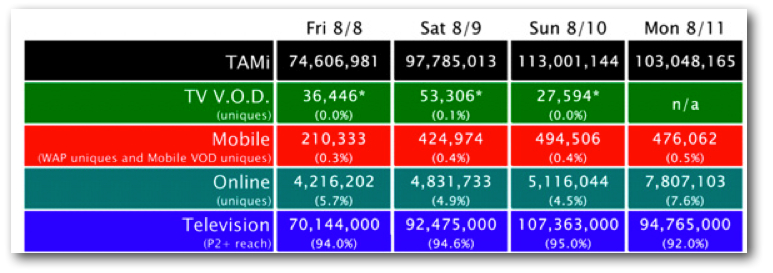
NBC showed off TAMi’s impressive measurements yesterday: after four days of coverage, an average of 96 million impressions across NBC and its other TV networks, online, mobile and VOD.
— The TV measure reached its high point Sunday with 107.4 million viewers watching at least a portion of the Olympics.
— More than 92% of the Games viewership is on TV, though online unique users jumped from 4.2 million on Friday (5.7% of the Olympic audience) to 7.8 million (7.6% of the audience) on Monday.
— Mobile usage increased from 210,000 on Friday to 476,062 on Monday. NBC research chief Alan Wurtzel said the company was stunned at the growth of mobile. VOD is statistically insignificant.
Beyond NBC’s interests and investments, TAMi looks attractive as a standard for all media companies to measure audience across platforms. To date, audience measurement has been diffuse, piecemeal and largely unreliable. Many companies have been disappointed by the results of what used to be known as “convergence,” or the distribution of news of information through multiple platforms. Many marketers, advertisers and agencies remain wary of numbers established for one platform, then applied to another. Most metrics of online usage remain unreliable: numbers cached and crunched by computers that misrepresent how people access and use information online.
TAMi could represent more than just a bigger number for cross-platform companies to quantify the size of their audiences. It could lead to a new way to quantify how people “use” an event.
One initial observation: NBC’s numbers suggest the company’s strategy of round-the-clock coverage — nearly 3,600 hours between TV and online, not to mention VOD — is expanding, rather than diluting, the market. That should help debunk the dangerous myth that online media cannibalizes core platforms and products.
More at CNN, New York Times, and paidContent.
Data from the TAMi release (PDF).